
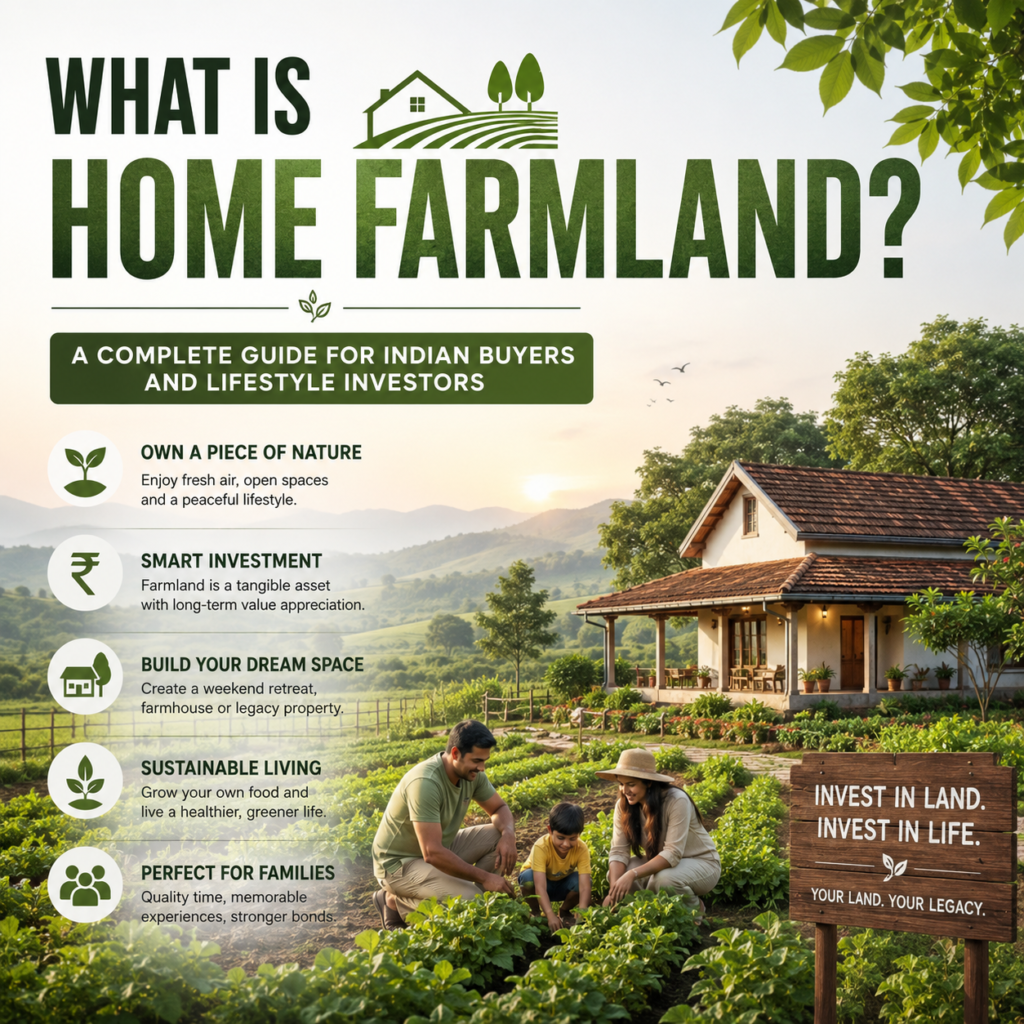
What Is Home Farmland? A Complete Guide for Indian Buyers and Lifestyle Investors
You’ve seen the phrase in listings, in weekend retreat brochures, and in the conversations of urban professionals who are tired of concrete. “Home farmland.” It sounds simple enough — a piece of land near your home where you grow things. But the concept is richer, more legally nuanced, and more financially interesting than it first appears.
This guide explains what home farmland actually means, how it differs from commercial agricultural land, the different forms it takes in India today, who it suits, and what you need to know before buying or setting one up.
What Is Home Farmland?
Home farmland is agricultural or peri-agricultural land that is used primarily for personal, household, or small-scale farming — as opposed to commercial production at scale. The defining characteristic is that the land is connected to a residence or used as an extension of domestic life, with produce mainly consumed by the owning family or shared locally, rather than sold through commercial supply chains.
In its simplest form, it is the land attached to or near a home where a family grows vegetables, maintains fruit trees, keeps a small livestock unit, or practices mixed subsistence farming. In its more evolved modern form — as it is increasingly understood in India’s urban and peri-urban context — home farmland includes:
- Weekend farmhouses with kitchen gardens on the outskirts of metro cities
- Managed farmland plots where urban investors own a portion of a professionally farmed estate and take home organic produce
- Homestead farms of 1–5 acres where a family lives, grows, and is substantially self-sufficient
- Hobby farms or “agri-retreats” near cities like Bengaluru, Pune, and Hyderabad, bought for lifestyle and investment rather than livelihood
All of these share a common thread: the land serves the home, not the other way around.
Home Farmland vs Commercial Agricultural Land: The Key Difference
While both involve agricultural land classification, they differ significantly in intent, scale, and management:
Parameter | Home Farmland | Commercial Agricultural Land |
Primary purpose | Family use, lifestyle, self-sufficiency | Crop production for sale / commercial income |
Scale | Typically 0.25–5 acres | Can range from 5 acres to hundreds of acres |
Labour | Owner/family managed, or lightly managed | Employs farm labour; professionally operated |
Produce | Consumed at home or shared locally | Sold through mandis, aggregators, or processors |
Irrigation | Usually bore well or rainwater harvesting | Canal-fed, tubewell, or drip irrigation at scale |
Investment goal | Lifestyle, food security, and long-term appreciation | Agricultural income generation and returns |
Location | Near residential areas or on property periphery | Typically in fertile rural zones |
The lines can blur — a managed farmland plot near Bengaluru may generate both lifestyle value and commercial income. But the starting intent distinguishes the two clearly.
Types of Home Farmland in India
1. Kitchen Garden or Home Plot (Under 0.25 Acres)
The smallest form — a backyard, terrace, or small plot attached to a home where vegetables, herbs, and fruit trees are grown. Not classified as agricultural land in revenue records if it falls within residential property, but functionally the oldest and most universal form of home farming.
In Indian cities, this is growing rapidly. India’s urban farming movement is community-driven and focuses on food self-sufficiency, with projects like the Mumbai Port Trust Garden converting unused urban spaces into community gardens across Mumbai, Delhi, and Bengaluru.
2. Homestead Farm (1–5 Acres)
A self-contained small farm where the family resides permanently or seasonally. Typically includes a residence, kitchen garden, fruit orchard, small livestock, a compost system, and water harvesting. This model is deeply rooted in traditional Indian rural life and is now being revived deliberately by urban families seeking a slower, more sustainable way of living.
Small-scale homestead farming of even 1 acre can support substantial self-sufficiency — it is not the size of the land that determines viability, but how efficiently it is used. Many homestead farmers combine food production with income-generating activities like agro-tourism, home stays, or the sale of surplus organic produce.
3. Weekend Farmhouse with Farming Activity
One of the most popular models among urban professionals in 2025. A farmhouse — often called a country home — is a residence set amid farmland or rural surroundings. Traditionally built for farmers to stay close to their fields, modern farmhouses have evolved into second homes, eco-stays, or weekend retreats for city residents.
When this farmhouse is accompanied by active farming — even as small as a kitchen garden, a fruit orchard, or an organic vegetable plot — it qualifies as home farmland in the practical sense. States like Rajasthan, Karnataka, Tamil Nadu, and Maharashtra are popular locations for this model.
4. Managed Farmland Plot (Fractional Home Farming)
A newer and rapidly growing model, particularly suitable for urban investors who want the benefits of farmland ownership without managing it themselves. In this collaborative model — pioneered by developers in Goa and Maharashtra — groups of buyers pool 100–200 acres of farmland, with professional managers handling day-to-day farming operations including irrigation, labour, and security. Each family takes home their share of the organic yield while land ownership remains a secure, appreciating asset.
This model bridges the gap between investment and lifestyle: you own real agricultural land, you receive organic produce from it, and you can visit it as a retreat — all without relocating or managing a farm yourself.
5. Urban Micro-Farm or Terrace Farm
The most compact form — balconies, terraces, and rooftops converted into productive food-growing spaces using raised beds, grow bags, vertical gardens, and hydroponics. Technically not classified as agricultural land (it falls within residential property), but represents the urban extension of the home farmland ethos: growing food where you live.
Why Home Farmland Is Gaining Momentum in India (2025)
Several converging forces are driving the home farmland movement across India:
Post-pandemic lifestyle reset: The experience of urban lockdowns sharply increased interest in food security, open spaces, and connection to nature. Many urban families who had never considered farming began exploring farmland ownership as a result.
Rising demand for organic produce: Mistrust of commercially grown, chemically treated food has grown steadily. Home farmland offers a direct answer — food you grew yourself or had grown for you on your own land.
Remote work flexibility: With a significant share of knowledge workers now working remotely full-time or part-time, the ability to live near or on a home farm without sacrificing income has become realistic for the first time.
Investment appeal: Many buyers are turning their farmland into weekend homes, food forests, or eco-retreats — blending investment with a desirable lifestyle — while agricultural income remains exempt from income tax under certain conditions, making it a favourable tool for tax planning.
Infrastructure improvement: With rapid infrastructure development like the Delhi-Mumbai Expressway and the Delhi-Dehradun Expressway, locations once considered “too far” are now within 2–3 hours’ reach, leading to a sharp rise in demand for plotted developments along these corridors.
Legal Status of Home Farmland in India
This is where most buyers stumble. Home farmland sits in a legally complex space because Indian land law does not have a specific “home farmland” category. Revenue records classify land as agricultural, residential, or non-agricultural — and the rules that apply depend on which classification your land carries.
If your home farmland is classified as agricultural land:
- It enjoys the tax benefits of agricultural land — farming income is exempt under Section 10(1) of the Income Tax Act.
- It must be used for farming — leaving it unused for extended periods may attract scrutiny or even penalties in some states.
- Construction on agricultural land is restricted — you cannot legally build a permanent residence on agricultural land without obtaining Change of Land Use (CLU) or conversion permission from the District Collector or State Revenue Department.
- Even a farmhouse on agricultural land requires planning permission from the local authority — CMDA, DTCP, or panchayat office — and construction must respect zoning regulations, setbacks, and FSI limits.
If your home farmland is classified as residential / converted land:
- You can freely construct a home on it.
- But you lose the agricultural tax benefits — income from farming this land may not qualify for exemption.
- Capital gains on sale will be taxed as a capital asset, not as agricultural land.
The practical route most buyers take:
Purchase agricultural land near a city, operate it as a home farm (kitchen garden, orchard, small livestock), and keep it in agricultural classification to preserve the tax status. A small, permitted farm structure or tool shed is constructed rather than a full residential building. Some states allow a farmhouse of a defined size to be built on agricultural land with appropriate permissions — the rules vary sharply by state.
What Can You Grow on a Home Farm?
The beauty of home farmland is its flexibility. Depending on the land size, climate, and water availability, a home farm in India can produce:
- Vegetables: Tomatoes, brinjal, leafy greens, beans, gourds — the staples of a South or North Indian kitchen
- Fruits: Mango, guava, papaya, banana, coconut, pomegranate — most yielding within 2–4 years
- Herbs and spices: Tulsi, curry leaves, ginger, turmeric, chillies — high-value, low-space crops
- Pulses and grains: For larger plots — moong, urad, jowar, bajra, or wheat, depending on region
- Livestock: Desi cows, goats, or poultry for personal dairy, meat, and egg requirements
- Medicinal plants: Ashwagandha, lemongrass, aloe vera — growing demand from ayurveda-oriented buyers
How Much Land Do You Need?
Home farmland does not require vast acreage. Here is a practical guide:
Goal | Recommended Size |
Kitchen garden (vegetables + herbs for family) | 500–2,000 sq ft |
Kitchen garden + small orchard | 0.25–0.5 acres |
Self-sufficient small homestead | 1–2 acres |
Homestead + small livestock + weekend retreat | 2–5 acres |
Managed farmland investment with produce share | 1–3 acres (in a pooled estate) |
Even in high-value districts like Alwar or Jaipur’s periphery, 1–2 acres of agricultural land is available in the ₹10–20 lakh range, making home farmland one of the most accessible entry points into land ownership for urban middle-class families.
Key Considerations Before Starting a Home Farm
Water availability is the single most important factor. A home farm without reliable water access — whether a bore well, rainwater harvesting system, or canal connection — will fail regardless of soil quality.
Soil health assessment before purchase or development is essential. A basic soil test (available through state agricultural universities for a few hundred rupees) reveals pH, organic content, and nutrient deficiencies that inform what you can grow and what inputs are needed.
Access to the land — road connectivity, proximity to the nearest town, and electricity availability — determines whether the farm is usable year-round or only seasonally.
Legal verification — check the revenue record classification, verify there are no encumbrances, confirm state-specific purchase eligibility, and clarify what structures can be legally built before committing.
Managed vs self-operated — if you cannot be physically present regularly, a professionally managed farmland model is significantly more practical than self-operating. Unmanaged agricultural land deteriorates quickly and may attract unwanted encroachment.
Home Farmland vs Farmhouse: Are They the Same?
Not exactly. A farmhouse refers primarily to the dwelling — the building structure situated amid farmland. Home farmland refers to the land itself and its farming use. Many people use the terms interchangeably, but the legal and functional distinction matters:
- You can have a farmhouse on converted (non-agricultural) land — in which case there is no home farmland, just a rural house.
- You can own home farmland without any structure on it — a plot of agricultural land you actively cultivate near your existing home.
- The ideal model combines both: agricultural land in active use, with a permitted farmhouse structure for residence or weekend stays.
Who Is Home Farmland Best Suited For?
Home farmland is not for everyone. It suits people who:
- Want a reliable source of organic food for their family without dependence on retail supply chains
- Seek a secondary asset that appreciates quietly while also providing lifestyle value
- Are interested in sustainable, low-chemical farming as a practice — not just as an idea
- Have the time, interest, or financial means to manage a small agricultural holding (directly or through a professional manager)
- Are planning retirement in a quieter, greener environment and want to establish that land well in advance
It is generally not suited for pure financial investors seeking the highest possible return — commercial agricultural land, managed farmland investments, or other asset classes will deliver better purely financial outcomes for that goal.
Final Thought
Home farmland represents one of the most human-scale relationships between people and land — a living, productive space that feeds your family, connects you to natural cycles, and builds quietly into a long-term asset. In India, where farming is not just an economic activity but a cultural inheritance, home farmland is both a return to roots and a forward-looking lifestyle choice.
The investment case is real. The lifestyle case is compelling. And the entry cost — especially in states like Rajasthan, Karnataka, Madhya Pradesh, and Tamil Nadu — remains accessible to far more people than assume it is.