
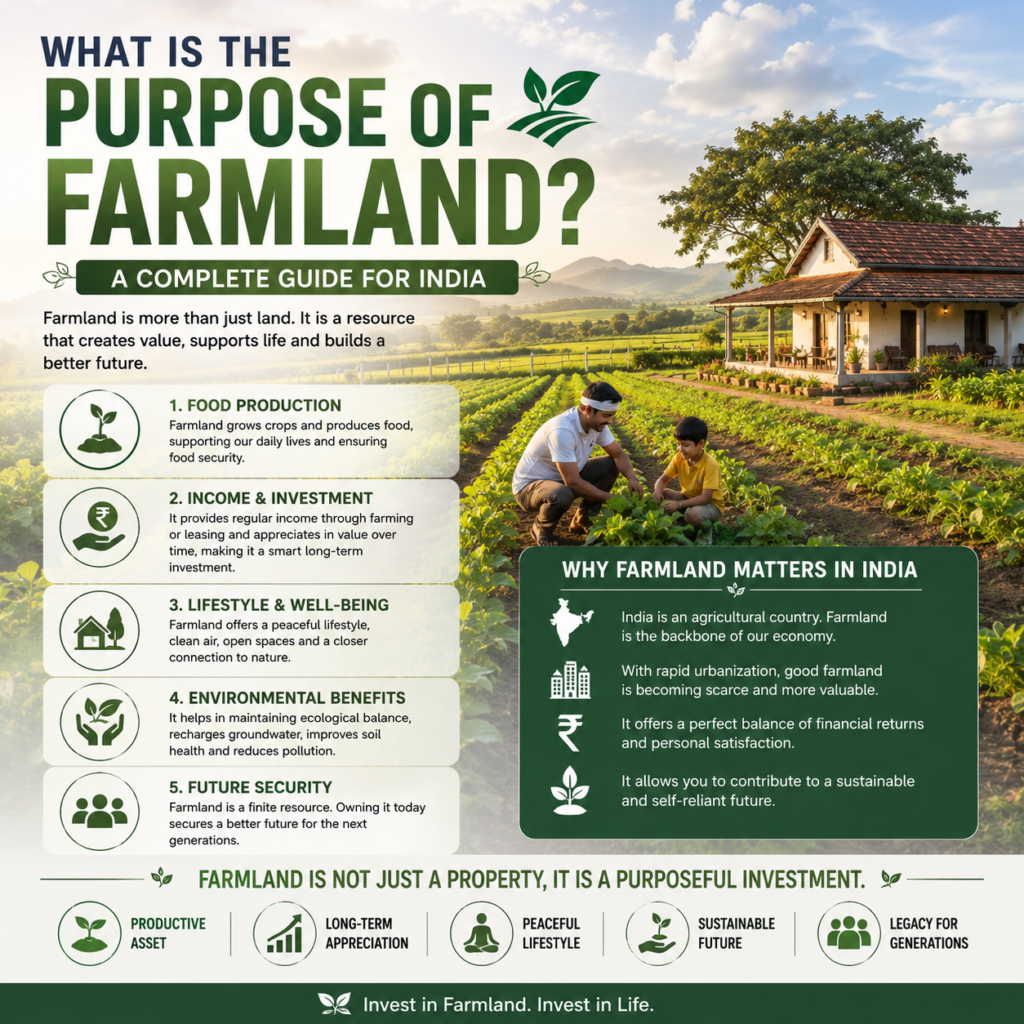
What Is the Purpose of Farmland? A Complete Guide for India
Ask most people why farmland exists and they will say: “to grow food.” That answer is correct — but it captures only a fraction of the truth. Farmland is simultaneously a food production system, an economic engine, an environmental asset, an energy source, an investment vehicle, and a cultural inheritance. In India especially, where agriculture touches nearly every dimension of national life, understanding the full purpose of farmland is essential — whether you are a farmer, an investor, a policymaker, or simply a citizen who eats.
This blog examines every major purpose farmland serves in India today, anchored in 2025–2026 data and ground-level realities.
1. Food Production: The Foundational Purpose
The oldest and most fundamental purpose of farmland is to produce food. Everything else is layered on top of this.
India’s farmland delivered a landmark result in 2024–25: a record 357.73 million tonnes of foodgrain production — an 8% rise over the previous year and 106 million tonnes higher than the country produced a decade ago in 2015–16. This output from approximately 157 million hectares of agricultural land feeds 1.4 billion people, making India one of the world’s most consequential food-producing nations.
The breakdown of what Indian farmland grows reveals its extraordinary scope:
- Cereals and pulses — rice, wheat, maize, jowar, bajra, arhar, moong — forming the nutritional base of the Indian diet
- Oilseeds — mustard, groundnut, soybean, sunflower — critical for edible oil self-sufficiency
- Vegetables and fruits — India is the world’s second-largest producer of vegetables and fruits
- Cash crops — cotton, sugarcane, jute, tobacco — raw materials for industry and export
- Spices — India is the world’s largest producer and exporter of spices, grown predominantly on smallholder farmland
Despite this abundance, food security remains an active challenge. Lower agricultural productivity due to climate volatility and reduced available farmland, partly driven by India’s rapidly increasing population and economic growth that strains natural resources and land availability, continues to put pressure on the sector.
2. Economic Engine: Livelihoods and GDP
Agriculture and allied activities contribute nearly 16–18% to India’s GDP and support the livelihoods of over 46% of the population — making farmland not just a food source but the economic foundation of rural India.
In absolute terms, India’s total agricultural GDP output is approximately USD 0.69 trillion in 2025, growing at a CAGR of 3.5–4.2%. The Union Budget 2025–26 allocated ₹1.52 lakh crore to agriculture and allied sectors, reflecting the sector’s political and economic centrality.
Agriculture serves as the primary source of income for nearly half of the Indian population, sustaining millions of livelihoods and supporting the broader ecosystem of allied industries in agro-processing, rural infrastructure, and commodity trading.
Export earnings: India is a significant agro-food exporter. The India-UK Free Trade Agreement signed on July 24, 2025, grants duty-free access to 95% of India’s agricultural and processed food exports — expected to boost agri exports by over 20% within three years, pushing toward the government’s USD 100 billion agricultural export target by 2030. India’s coffee exports alone grew 27% in January–April 2026.
Income assurance: The Minimum Support Price (MSP) policy continued as a pillar of income assurance in 2024–25, guaranteeing at least a 50% return over cost of production for notified crops — directly linking farmland productivity to rural purchasing power.
3. Energy Production: Farmland’s Newest Purpose
One of the most significant shifts in Indian farmland use over the past decade is the emergence of energy production as a genuine primary purpose — no longer peripheral, but central to national strategy.
Bioenergy and ethanol: India’s Ethanol Blending Programme reached 19.05% blending by July 2025, with the country redirecting record rice and sugarcane stocks towards ethanol production to support its 20% blending target. This reduces crude oil imports, cuts carbon emissions, and provides additional income directly to farmers growing energy crops.
Bioenergy from crop residues alone could generate 20 GW of power according to the NITI Aayog Energy and Agriculture Nexus Report 2025 — a significant proportion of which would come from agricultural waste currently being burnt in fields.
Solar energy on farmland (Agri-PV): Solar power has become India’s largest renewable energy source, with an installed capacity of approximately 150 GW as of FY 2025–26. A significant share of this capacity sits on agricultural land, particularly in Rajasthan, Gujarat, and Tamil Nadu. The emerging model of agro-photovoltaics (Agri-PV) — farming under solar panels — can enhance land productivity by up to 60%, simultaneously producing crops and electricity from the same land parcel, as piloted in Rajasthan and Tamil Nadu.
Under PM-KUSUM, solar pump installations have expanded across agricultural India, fostering renewable energy adoption and decentralised solar power generation on farmlands — reducing diesel costs for millions of farmers and improving energy access in remote areas.
4. Environmental Services: What Farmland Does for the Planet
Agricultural land is not merely an economic system — it is an ecological one. Well-managed farmland provides a suite of environmental services that benefit the broader population:
Carbon Sequestration
Every acre maintained with agroforestry or organic farming promotes carbon sequestration, groundwater recharge, and soil fertility. By growing trees alongside crops, covering soils, and avoiding tillage, Indian farmland has the potential to become a significant carbon sink. Carbon farming — the practice of farming specifically to sequester atmospheric carbon — is gaining traction in India, with carbon markets now offering farmers additional income for storing carbon in their soil and biomass.
Groundwater Recharge
Farmland with good soil cover and organic matter acts as a natural sponge, absorbing rainfall and recharging groundwater aquifers. Concrete, roads, and buildings do not. As India urbanises rapidly and groundwater depletion intensifies, the role of agricultural land in sustaining groundwater levels has become a critical environmental service — one that is lost permanently when farmland is converted to urban use.
Biodiversity Support
Farmlands support a wide range of flora and fauna — birds, pollinators, soil microorganisms, and small mammals — that would not survive in urban or industrial landscapes. Integrated farming systems, agroforestry, and organic cultivation actively enhance this biodiversity. The erosion of biodiversity within farmland can result in negative feedback on agricultural yields themselves, creating a direct link between ecological health and food production.
Soil Health and Erosion Prevention
Planted farmland stabilises soil, preventing wind and water erosion. In hilly and semi-arid regions, terraced farmland and agroforestry are the primary mechanisms keeping topsoil in place and preventing desertification. Healthy agricultural soils are one of the world’s most irreplaceable natural resources — and farmland is where they are created, maintained, and, when poorly managed, destroyed.
Climate Regulation
Farmland moderates local temperatures, reduces the urban heat island effect, and contributes to rainfall patterns through transpiration. Large-scale loss of agricultural land to urban development — a pattern accelerating in India — disrupts these regulatory functions at the regional level.
5. Raw Material Supply for Industry
Beyond food, farmland supplies the raw materials that power a wide range of Indian industries:
- Textiles: Cotton grown on Deccan Plateau farmland supplies India’s massive textile industry — one of the country’s largest employment sectors.
- Sugar and confectionery: Sugarcane from Maharashtra, Uttar Pradesh, and Karnataka feeds the sugar industry, worth over ₹1 lakh crore annually.
- Pharmaceuticals and ayurveda: Medicinal plant cultivation — ashwagandha, brahmi, senna, aloe vera — is a growing farmland use supporting India’s pharmaceutical and nutraceutical industries.
- Rubber and latex: Plantation farmland in Kerala and Tamil Nadu supplies the tyre, adhesive, and surgical product industries.
- Biofuels and chemicals: Jatropha, maize, and sugarcane contribute to India’s ethanol and biodiesel supply chains.
6. Investment and Wealth Preservation
In the Indian context, farmland has long served as a store of generational wealth — a purpose that has become more formally recognised as an investment category in recent decades.
Farmland serves this purpose through three mechanisms:
Capital appreciation: Agricultural land in well-located districts — near highways, cities, irrigation projects, or solar zones — has consistently appreciated over the long term. Districts like Alwar, Hosur, Chikkaballapur, and Shadnagar have seen double-digit land price growth.
Agricultural income (tax-exempt): Farming income from agricultural land is exempt from income tax under Section 10(1) of the Income Tax Act. This makes productive farmland one of the most tax-efficient income-generating assets available to Indian investors.
Hedge against inflation: Land, particularly agricultural land, has historically maintained its purchasing power better than most financial instruments during inflationary periods, because its productive output (food) is itself an inflation driver.
ESG and sustainable investment: Farmland certified as organic or climate-smart attracts premium valuations — sometimes 15% higher than conventional land — as ESG investing channels capital into sustainable farmland projects.
7. Rural Employment and Social Infrastructure
Farmland is the employment backbone of rural India. The sector directly and indirectly supports the livelihoods of over 600 million Indians — a scale no other sector comes close to matching.
This employment extends well beyond the primary act of cultivation. Agricultural land supports:
- Farm labour (planting, weeding, harvesting, threshing)
- Agro-processing (milling, ginning, pressing, cold storage)
- Transport and logistics (produce movement from farm to market)
- Allied services (veterinary services, equipment repair, input supply)
- Agro-tourism and farm stay operations
Schemes like ATMA, STRY, and PM-KVVY have built a robust rural skilling ecosystem that trains farmers, women, and youth in modern farming and agri-entrepreneurship — linking farmland to rural upward mobility.
8. Cultural Heritage and Psychological Well-being
In India, farmland is not just an economic asset. It is a carrier of culture, tradition, identity, and memory. The relationship between the Indian people and agricultural land is among the most deeply embedded in the world.
Festivals like Pongal, Baisakhi, Onam, Ugadi, and Makar Sankranti are all agricultural celebrations — marking sowing, harvesting, and the turning of seasons. The rhythm of farmland is the rhythm of rural Indian life.
Beyond cultural significance, access to green, open farmland has measurable psychological benefits. The growing movement of urban professionals buying weekend farmhouses and home farms reflects a documented need for connection to nature, open space, and physical engagement with food production — a need that increasingly sterile urban environments cannot meet.
9. National Security and Strategic Importance
Food security is a component of national security. A country that cannot feed itself is strategically vulnerable — dependent on import supply chains, global price shocks, and foreign policy relationships for the most basic necessity of its population.
India’s farmland is the physical infrastructure of its food sovereignty. The record grain production of 357.73 million tonnes in 2024–25 is not just an agricultural statistic — it is a national security asset. India’s ability to maintain strategic food reserves, export agricultural commodities as diplomatic tools, and withstand global supply shocks depends directly on the health, productivity, and extent of its farmland.
How the Purposes of Farmland Interact
These purposes are not independent — they reinforce and sometimes compete with each other:
- Food production vs energy production: Converting crop-producing land to biofuel or solar generation reduces food output but gains energy independence. Agri-PV offers a partial resolution by layering both uses on the same land.
- Investment returns vs food security: Selling agricultural land to developers generates private wealth but permanently removes food-producing capacity from the national inventory.
- Biodiversity vs yield maximisation: High-input monoculture farming maximises short-term yields but degrades the biodiversity and soil health that sustain long-term productivity.
- Urban expansion vs groundwater: Replacing farmland with impervious urban surfaces reduces groundwater recharge, ultimately affecting water security for the cities being built.
A Quick Reference Summary
Purpose | What It Delivers | Scale in India |
Food production | Staples, vegetables, fruits, pulses | 357.73 MT foodgrains (2024–25 record) |
Economic livelihood | Income for rural households | 46% of population dependent |
GDP contribution | National output | ~16–18% of GDP |
Export earnings | Foreign exchange | USD 100 billion target by 2030 |
Energy production | Ethanol, solar, bioenergy | 19.05% ethanol blending (July 2025) |
Carbon sequestration | Climate mitigation | Significant untapped potential |
Groundwater recharge | Water security | Critical in depleted zones |
Biodiversity support | Ecosystem health | Supports pollinators, soil organisms |
Industrial raw materials | Textiles, sugar, rubber, pharmaceuticals | ₹1 lakh crore+ sugar industry alone |
Investment / wealth | Capital appreciation, tax-exempt income | Double-digit appreciation in key districts |
Employment | Rural livelihoods | 600 million+ dependent |
Cultural heritage | Identity, tradition, festivals | Inseparable from Indian civilisation |
National food security | Strategic sovereignty | Food self-sufficiency of 1.4 billion |
Final Thought
The purpose of farmland is not one thing. It is many things simultaneously — and the balance between those purposes is constantly being renegotiated as India grows, urbanises, and faces the twin pressures of climate change and population growth.
Farmland that is well-managed, fairly owned, and wisely invested in is one of the most productive assets a civilisation can hold. Farmland that is degraded, neglected, or carelessly converted is a loss that compounds invisibly over decades — in food security, in water tables, in biodiversity, and in the livelihoods of hundreds of millions of people who have no fallback.
For India, protecting the purpose of farmland — in all its dimensions — is not just an agricultural policy question. It is a question of what kind of country we want to be.