
Why Is It Called a Farm? The Surprising History Behind a Word We Use Every Day
You’ve said the word a hundred times. Farm. Farmland. Farm fresh. Farm to table. But have you ever stopped and wondered — why is it called a farm in the first place? Where did the word come from? And what does its history tell us about land, ownership, and value?
The answer takes us back over a thousand years — and it turns out, the story of the word “farm” is also the story of how land became wealth.
The Origin of the Word “Farm”
The word farm does not originally mean a place where crops grow. That might surprise you.
The word comes from the Medieval Latin word “firma” — which meant a fixed payment or settled rent. In the Middle Ages across Europe, when a landowner leased out land to a tenant, the tenant paid a “firma” — a fixed, agreed sum — for the right to use that land and keep whatever it produced.
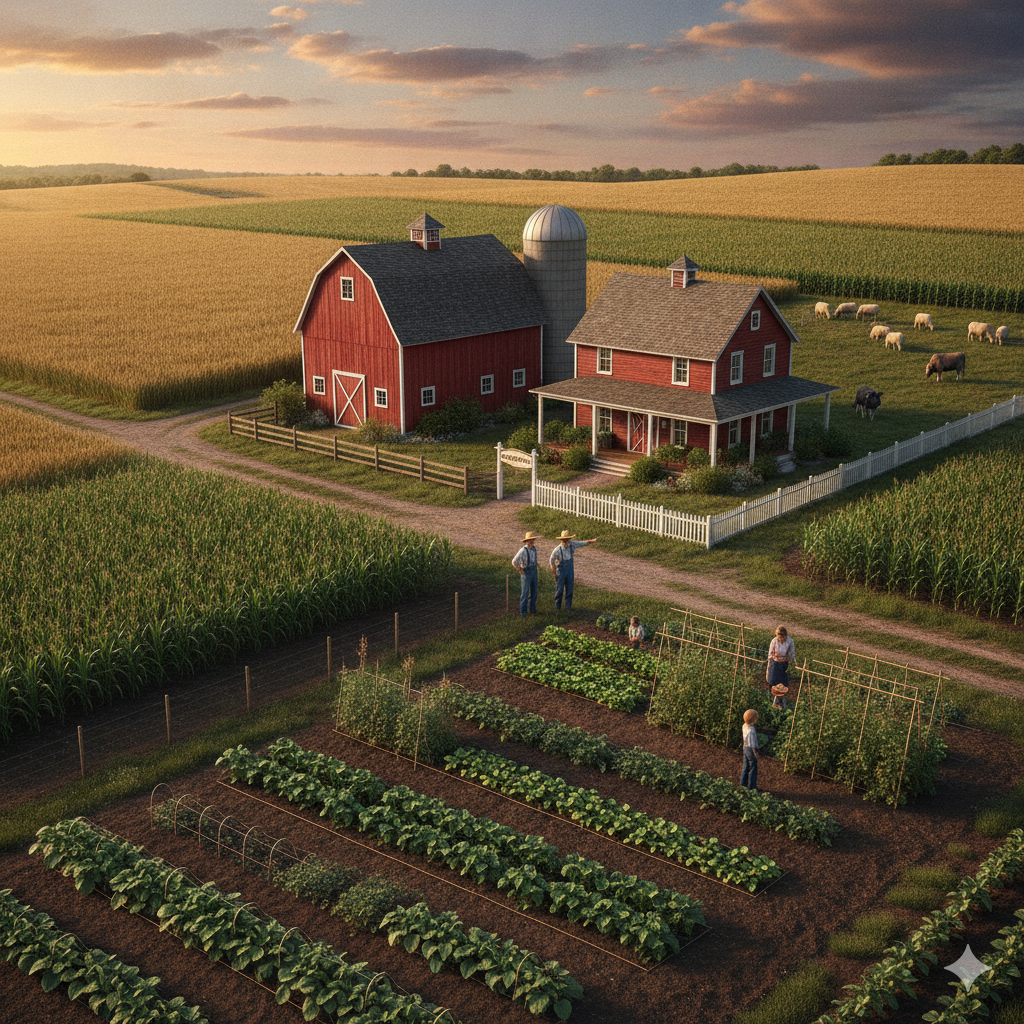
Over time, the land itself that was rented out under this fixed payment arrangement came to be called a “farm.” The Old French picked it up as “ferme” — meaning rented land. The English language absorbed it from there, and by the 14th and 15th centuries, “farm” had evolved to mean any tract of land used for agricultural purposes — whether rented or owned outright.
So at its root, a farm was not defined by what grew on it. It was defined by the financial arrangement around land. It was about ownership, rent, and the value of productive land.
That connection between farmland and financial value is not a modern invention. It is baked into the very word itself.
How the Meaning Evolved Over Centuries
As agricultural economies matured and land ownership became more widespread, the word “farm” shifted from describing a rental arrangement to describing the physical place where food was grown.
By the 16th century in England, a farm was understood as a piece of land with a house, outbuildings, fields, and livestock — a working agricultural unit. The person who worked it was called a farmer — originally meaning someone who paid a fixed rent, and later meaning anyone who cultivated land for a living.
The Industrial Revolution in the 18th and 19th centuries further transformed what a farm meant. Farms became more mechanized, more productive, and more connected to markets. The small subsistence plot gave way to larger commercial agricultural operations — and “farm” became the universal word for any land dedicated to food production.
What Different Cultures Called Their Farms
The concept of a farm — cultivated land tied to a community’s survival — is universal. But different civilizations had their own words for it.
Ancient India — “Kshetra”
In Sanskrit, agricultural land was called Kshetra — meaning field or domain. The Bhagavad Gita famously opens with the phrase “Kurukshetra” — the field of action. In ancient Indian thought, the farm was not just an economic unit but a sacred one — land as the source of all life and dharma.
Ancient Rome — “Fundus” and “Ager”
Romans used fundus for a farm estate and ager for cultivated field. Roman agricultural writing — from Cato, Columella, and Virgil — treated farming as the most noble profession. Virgil’s Georgics is essentially a poem about farming, written with the reverence most cultures reserve for warfare or religion.
Ancient Egypt — The Gift of the Nile
Egyptian farmers did not have a word equivalent to “farm” as a fixed property. Instead, land was tied to the annual Nile flood cycle. After the waters receded, farmers would cultivate the rich alluvial deposits left behind — and the land essentially reset every year. Land was not owned so much as borrowed from the river.
Japan — “Nōchi” (農地)
Japanese agricultural land is called nōchi, combining the characters for agriculture (農) and land (地). Japanese farming culture — particularly rice cultivation — has shaped everything from the country’s aesthetics to its social structure. Rice paddies are not just farms; they are cultural institutions.
India Today — “Khet” and “Bhoomi”
In Hindi and many Indian languages, khet means farm field, and bhoomi means earth or land. In Kannada — relevant to our Karnataka audience — hola means farm field and bhumi means land. These words carry deep cultural and spiritual weight in a country where land has always been the primary source of identity, security, and wealth.
The Farm in Indian History
India’s relationship with the farm is ancient, complex, and deeply emotional.
The Indus Valley Civilization — one of the world’s earliest urban cultures — was supported by sophisticated agriculture along the Indus and Saraswati rivers as far back as 3000 BCE. Farmers grew wheat, barley, cotton, and sesame. Irrigation channels, granaries, and standardized weights suggest a highly organized agricultural economy.
Through the Vedic period, the Maurya Empire, the Gupta golden age, and the Mughal era — farms and farmland formed the backbone of the Indian economy. Land revenue was the primary source of income for every ruling power. Kings rose and fell based on how well they managed agricultural land and its farmers.
The British colonial period introduced the Zamindari system — a land revenue arrangement that ironically echoes the original Latin meaning of “farm” as a fixed payment. Zamindars collected rent from tenant farmers on behalf of the colonial government. This system concentrated land in the hands of a few and created cycles of rural poverty that India is still working to address.
Post-independence land reforms — including the Karnataka Land Reforms Act of 1961 — were designed to break up large landholdings and distribute agricultural land to actual tillers. The idea was simple: land should belong to those who farm it.
The Farm as a Symbol
Across cultures and centuries, the farm has been more than an economic unit. It has been a symbol.
Of Stability — In a world of uncertainty, a farm represented something permanent. You could plant a seed and trust that the earth would do its work. Civilizations that lost their farms — through drought, conquest, or mismanagement — collapsed. Those that protected their farms endured.
Of Independence — To own a farm was to be free. Not dependent on an employer, a market, or a landlord. This is why land ownership has historically been the most powerful form of wealth — and why those in power have always tried to control it.
Of Identity — In Karnataka, land is not just an asset. It is ancestry. Families trace their roots to specific villages, specific fields. The farm is where the family came from. This emotional connection to land runs deeper than any financial calculation.
Of Aspiration — Today, for the urban professional who has spent a decade in a Bengaluru apartment, the farm represents something they’ve lost — or never had. Space. Quiet. Connection to nature. The ability to grow something. This aspiration is real, and it is driving a new generation of farmland investment across India.
From “Firma” to Farm Investment — The Full Circle
Here is what is fascinating: the word “farm” began as a financial concept — a fixed payment for productive land. Centuries later, farmland investment is once again being understood in exactly those terms — as a financial asset with measurable returns, long-term appreciation, and income potential.
The wheel has come full circle.
Urban professionals and NRI investors today are approaching farmland the way medieval landowners did — not necessarily to farm it themselves, but to own productive land, have it managed by someone else, and receive the income and value it generates.
The structure is different. The legal framework is modern. But the underlying idea — that land produces value, and owning land is owning a piece of that value — is as old as the word itself.
What a Farm Means Today in Karnataka
In the Bengaluru–Mysuru corridor today, a farm is:
- A mango orchard on the outskirts of Mysuru, managed by professionals while you work in the city
- A sandalwood and coconut plot near Kanakapura that appreciates quietly over 15 years
- A weekend escape from the noise of Bengaluru — fresh air, open skies, your own land
- A legacy asset you can pass on to your children
- An inflation hedge in a world of unpredictable markets
It is everything the word has always meant — productive, valuable, grounding, and yours.