
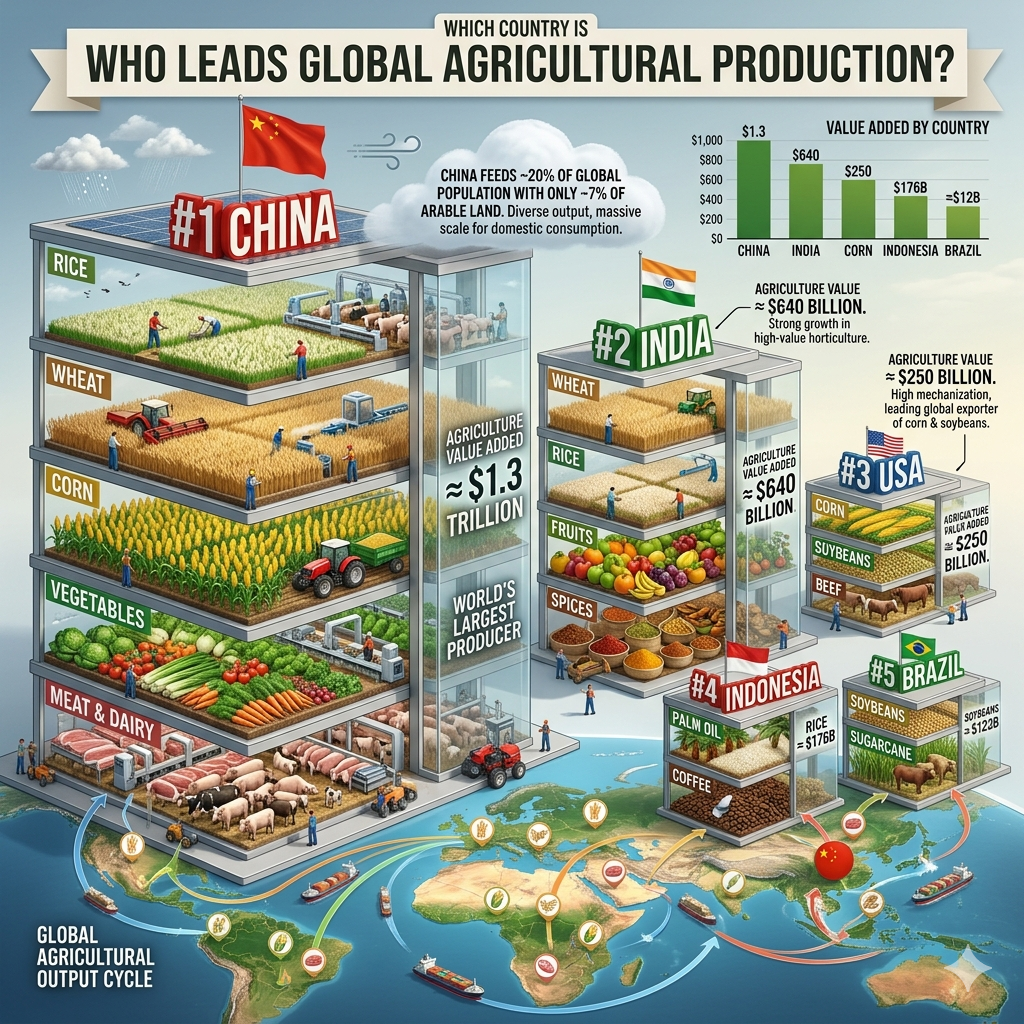
Which Country Is the Largest Agricultural Producer?
Introduction
Agriculture is the backbone of the global economy, providing food, raw materials, and employment to billions of people. When we talk about the largest agricultural producer in the world, we are referring to the country that produces the highest total value and volume of agricultural goods such as crops, livestock, and food products.
So, which country leads global agriculture?
The answer is:
China is the largest agricultural producer in the world, followed closely by India and the United States depending on the measurement (value vs. output).
Let’s understand this in detail.
1. China – The Largest Agricultural Producer
China
China is widely recognized as the world’s largest agricultural producer in terms of total output value.
Why China is the largest:
- Extremely large population requiring massive food production
- Intensive farming systems
- Strong government support for agriculture
- Advanced irrigation and technology use
Major agricultural products:
- Rice
- Wheat
- Corn (maize)
- Vegetables
- Pork (largest pork producer globally)
China’s agriculture is highly diverse and highly productive due to intensive land use.
2. India – One of the Largest Agricultural Producers
India
India is one of the largest agricultural producers in the world by volume of many crops.
Why India is a major producer:
- Large agricultural workforce
- Fertile river plains
- Monsoon-based farming system
- Wide crop diversity
Major agricultural products:
- Rice (one of the largest producers globally)
- Wheat
- Sugarcane
- Pulses
- Milk (India is the largest milk producer in the world)
India is especially strong in labor-intensive agriculture.
3. United States – Largest Export-Oriented Producer
United States
The United States is a global leader in commercial and export agriculture.
Why the U.S. is a top producer:
- Large-scale mechanized farming
- High efficiency and productivity
- Advanced agricultural technology
Major agricultural products:
- Corn (largest producer globally)
- Soybeans
- Wheat
- Cotton
- Beef and poultry
The U.S. dominates global agricultural exports.
4. Brazil – Major Agricultural Powerhouse
Brazil
Brazil is one of the fastest-growing agricultural producers.
Key strengths:
- Large land availability
- Expansion of farmland in tropical regions
- Strong agribusiness sector
Major products:
- Soybeans
- Coffee
- Sugarcane
- Beef
Brazil is a top global exporter of soybeans and meat.
5. Russia – Major Grain Producer
Russia
Russia plays a major role in global grain supply.
Key products:
- Wheat (one of the largest exporters)
- Barley
- Sunflower seeds
Large land area and fertile steppe regions support agriculture.
Global Comparison of Agricultural Leaders
Rank | Country | Strength |
1 | China | Highest total agricultural output |
2 | India | Largest in many staple crops |
3 | United States | Most efficient commercial farming |
4 | Brazil | Major exporter of soybeans & beef |
5 | Russia | Major grain exporter |
How “Largest Agricultural Producer” Is Measured
There are two main ways to measure:
1. Total Production Value
- Based on economic value of all agricultural goods
- China ranks #1
2. Crop Volume
- Based on quantity of specific crops
- India and the U.S. often lead in different categories
So the “largest” can vary depending on the metric.
Why China Leads Global Agriculture
China’s leadership comes from:
- Massive domestic demand
- Intensive farming techniques
- Strong government investment
- Efficient use of limited farmland
Even with less arable land per person, productivity is very high.
India’s Special Position in Agriculture
India is unique because:
- It has the largest population dependent on agriculture
- Produces a wide variety of crops
- Leads in milk production globally
- Has one of the largest cultivated land areas
Challenges Faced by Top Agricultural Countries
Even leading producers face issues:
- Climate change
- Water scarcity
- Soil degradation
- Rising production costs
- Land fragmentation (especially in India and China)
Future of Global Agriculture
The future of agricultural leadership will depend on:
- Smart farming technology
- Climate-resilient crops
- Sustainable agriculture
- AI and precision farming
- Improved supply chains
Countries investing in innovation will maintain global leadership.
Conclusion
The largest agricultural producer in the world is China, followed closely by India and the United States depending on how production is measured. Each country has unique strengths—China leads in total output, India excels in diverse crop production, and the United States dominates in efficiency and exports.