
What Is the Best Farming Land in the World? Top Fertile Regions Explained
Introduction
The quality of farmland plays a major role in determining agricultural productivity. Some regions in the world naturally have extremely fertile soil, good rainfall, and favorable climates that make farming highly productive. These areas are often referred to as the best farming lands in the world.
But there is no single “best” farmland universally. Instead, several regions are considered top-tier based on soil fertility, climate conditions, water availability, and farming efficiency.
In this blog, we will explore the best farming lands in the world and understand why they are so productive.
What Makes the Best Farming Land?
Before identifying regions, it is important to understand what defines excellent farmland:
1. Fertile Soil
Soil rich in nutrients such as nitrogen, phosphorus, and potassium supports high crop yields.
2. Reliable Water Supply
Rivers, rainfall, and irrigation systems are essential.
3. Suitable Climate
Moderate temperatures and stable weather conditions help crops grow consistently.
4. Flat Terrain
Plains are easier to farm and support large-scale agriculture.
5. Modern Farming Practices
Technology, machinery, and irrigation improve productivity even further.
Top Regions With the Best Farming Land in the World
1. Indo-Gangetic Plains (India)
India
The Indo-Gangetic Plains are considered one of the most fertile and productive agricultural regions in the world.
Why it is the best:
- Rich alluvial soil deposited by rivers
- Abundant water from Ganga, Yamuna, and Brahmaputra rivers
- Favorable monsoon climate
- Multiple cropping seasons in a year
Major crops:
- Rice
- Wheat
- Sugarcane
- Pulses
This region is often called the food bowl of India.
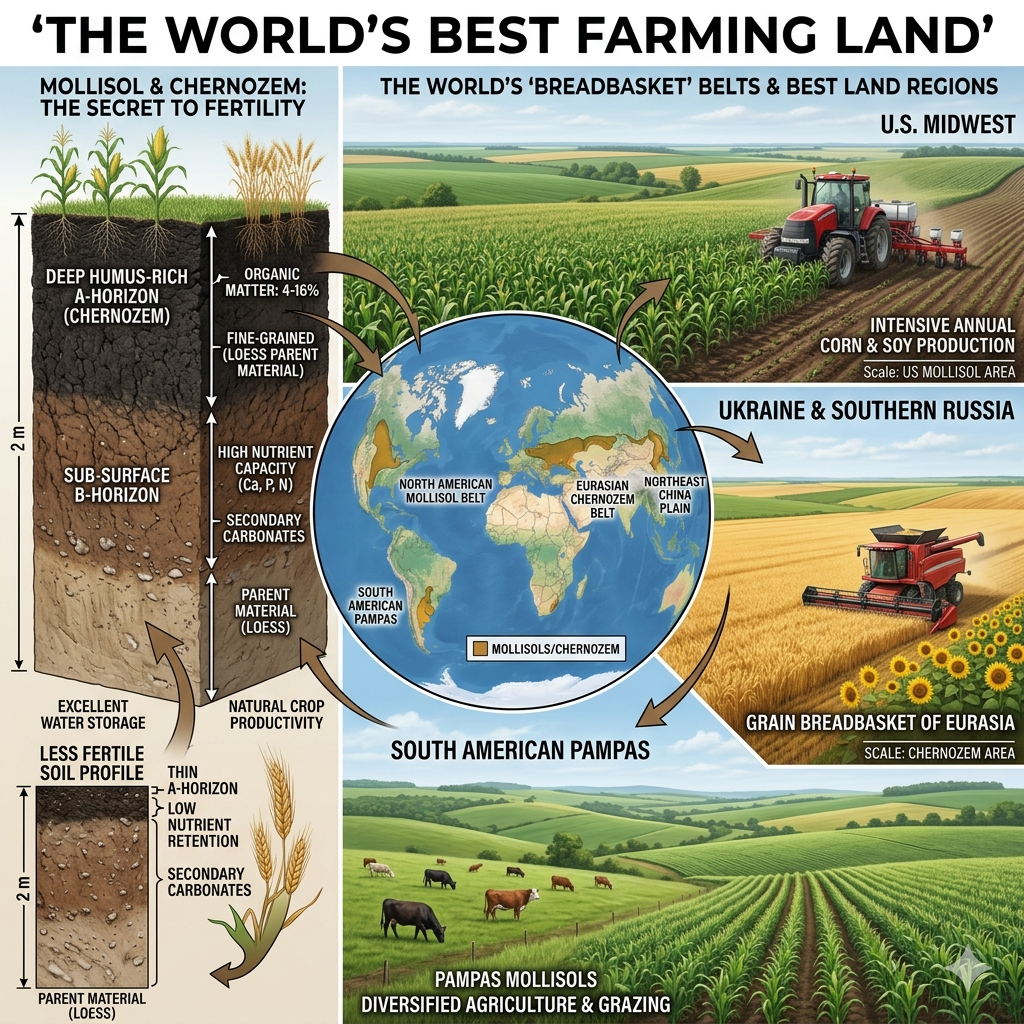
2. U.S. Midwest (Corn Belt)
United States
The American Midwest is one of the most productive farming regions globally.
Why it is excellent:
- Fertile prairie soils (Mollisols)
- Advanced mechanized farming
- Efficient irrigation systems
- Large-scale commercial agriculture
Major crops:
- Corn
- Soybeans
- Wheat
This region is a global leader in grain production.
3. North China Plain
China
One of the most important agricultural regions in Asia.
Key features:
- Highly fertile loess soil
- Extensive river systems
- Long history of cultivation
- Intensive farming practices
Crops:
- Wheat
- Rice
- Corn
- Vegetables
4. Pampas Region (Argentina)
Argentina
The Pampas are vast grasslands with rich agricultural soil.
Why it is productive:
- Deep, fertile soil
- Flat terrain
- Suitable temperate climate
Farming:
- Wheat
- Soybeans
- Cattle ranching
5. Nile River Valley
Egypt
A narrow but highly fertile agricultural strip.
Why it is productive:
- Nutrient-rich silt from Nile floods
- Year-round irrigation farming
- Desert-surrounded fertile land
Crops:
- Wheat
- Rice
- Cotton
6. European Farmland
France and nearby regions
Europe has some of the most advanced and productive farmland.
Why it is good:
- Moderate climate
- Advanced agricultural technology
- Fertile soils
- Strong farming systems
Crops:
- Wheat
- Barley
- Grapes (wine production)
Is There One “Best” Farming Land?
No single region can be called the absolute best because:
- Different crops need different conditions
- Technology can improve poor soil
- Climate varies across regions
- Irrigation can transform dry areas into productive farmland
For example:
- Rice thrives in wet regions
- Wheat grows best in temperate climates
- Cotton prefers black soil
India’s Importance in Global Farming
India plays a major role in global agriculture due to:
- Large fertile plains
- Monsoon-based farming system
- Diverse crop production
- Large farming population
India is among the top producers of rice, wheat, milk, and vegetables.
Challenges Facing Fertile Farmland
Even the best farmland faces issues such as:
- Climate change
- Soil degradation
- Water scarcity
- Urban expansion
- Overuse of chemicals
Future of Farming Land
The future of farming will depend on:
- Precision agriculture
- Smart irrigation systems
- Sustainable farming practices
- Climate-resilient crops
- Technology-driven farming
These innovations will help increase productivity even in less fertile regions.
Conclusion
The best farming land in the world is found in regions like the Indo-Gangetic Plains, U.S. Midwest, North China Plain, Pampas of Argentina, Nile Valley, and European farmland. These areas are highly productive due to fertile soil, good climate, and advanced farming systems.
However, there is no single best farmland globally. Productivity depends on a combination of natural conditions and modern agricultural technology.
Understanding these regions helps us appreciate how global food production is shaped and how important farmland is for human survival.