
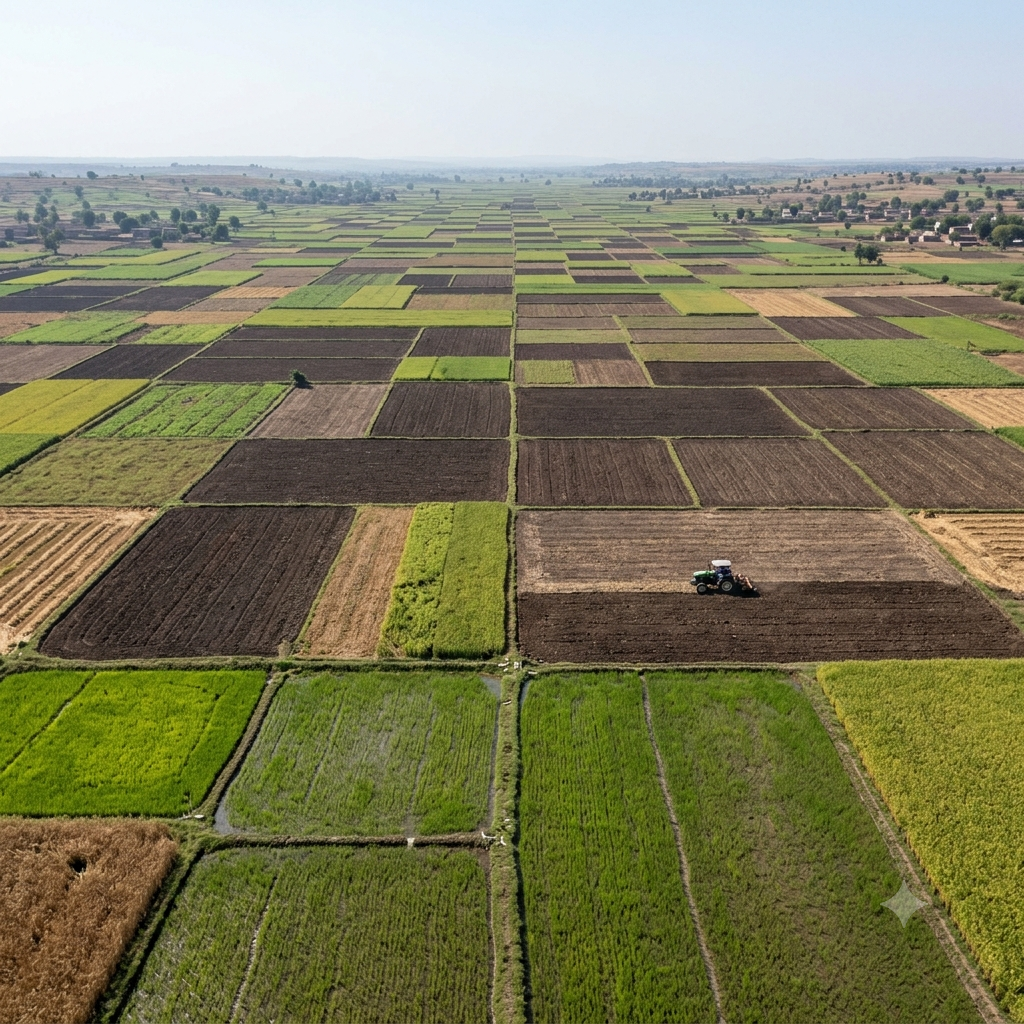
Net Sown Area & Agricultural Land Statistics in India
The Net Sown Area & Agricultural Land Statistics in India is a key indicator of how land is being used for agriculture and food production in the country. It represents the portion of land actually used for cultivation during a given agricultural year. Understanding the Net Sown Area & Agricultural Land Statistics in India is important for farmers, policymakers, researchers, and investors because it directly reflects agricultural productivity and food security.
India, being an agrarian economy, depends heavily on cultivated land, and analyzing net sown area trends helps understand changes in farming patterns, urban expansion, and land use efficiency.
What is Net Sown Area?
Net Sown Area (NSA) refers to the total area on which crops are sown and harvested at least once during the agricultural year.
In simple terms:
- It is the land actually used for farming
- It excludes forests, wasteland, and non-agricultural land
- It is a subset of total cropped area
The Net Sown Area & Agricultural Land Statistics in India helps measure how much land is actively contributing to food production.
Net Sown Area & Agricultural Land Statistics in India Overview
The Net Sown Area & Agricultural Land Statistics in India shows how agricultural land is distributed and utilized across the country.
Key highlights:
- India has one of the largest cultivated areas in the world
- Agriculture still occupies a major share of land use
- Net sown area has remained relatively stable over the years
- Growth is limited due to urbanization and industrial expansion
Despite economic diversification, agriculture remains a major land-use sector in India.
Total Agricultural Land in India
Agricultural land in India includes:
- Net sown area
- Fallow land
- Permanent pastures
- Agricultural plantations
Key observations:
- Around half of India’s total land is used for agriculture-related activities
- Net sown area forms the largest component of agricultural land
- Irrigated land is increasing but rain-fed agriculture still dominates
This makes land use efficiency a critical part of the Net Sown Area & Agricultural Land Statistics in India.
State-wise Net Sown Area Distribution
The Net Sown Area & Agricultural Land Statistics in India varies significantly across states due to geography, climate, and irrigation availability.
High net sown area states:
- Uttar Pradesh
- Punjab
- Madhya Pradesh
- Rajasthan
- Maharashtra
Lower net sown area states:
- Himachal Pradesh
- Arunachal Pradesh
- Kerala (due to forests and terrain)
States with fertile plains and irrigation systems generally have higher cultivated land.
Factors Affecting Net Sown Area in India
Several factors influence the Net Sown Area & Agricultural Land Statistics in India:
1. Urbanization
Expansion of cities reduces agricultural land.
2. Industrial development
Factories, highways, and infrastructure projects occupy farmland.
3. Irrigation facilities
Better irrigation increases cultivable land usage.
4. Soil fertility
Fertile soil encourages higher cultivation intensity.
5. Climate conditions
Droughts and floods impact cropping patterns.
Cropping Intensity and Agricultural Land Use
Cropping intensity plays a major role in the Net Sown Area & Agricultural Land Statistics in India.
Cropping intensity refers to the number of crops grown on the same land in a year.
Types:
- Single cropping
- Double cropping
- Multiple cropping
Higher cropping intensity increases productivity without increasing land area.
Importance of Net Sown Area in India
The Net Sown Area & Agricultural Land Statistics in India is important for several reasons:
Food security
More cultivated land ensures higher food production.
Economic planning
Helps government design agricultural policies.
Resource allocation
Supports irrigation and subsidy distribution.
Investment decisions
Important for agribusiness and rural development planning.
Trends in Agricultural Land Use
Recent trends in the Net Sown Area & Agricultural Land Statistics in India show:
- Slow increase in total cultivated land
- Decline in agricultural land in urban regions
- Growth in high-yield farming practices
- Shift toward horticulture and cash crops
These trends reflect modernization of Indian agriculture.
Challenges in Agricultural Land Management
India faces several challenges in maintaining optimal Net Sown Area & Agricultural Land Statistics in India:
- Rapid urban expansion
- Soil degradation
- Water scarcity
- Fragmented land holdings
- Climate change impact
These challenges affect long-term agricultural sustainability.
Government Initiatives for Agricultural Land Use
To improve land productivity, the government supports:
- Irrigation development projects
- Soil health card schemes
- Sustainable agriculture programs
- Land consolidation policies
- Digital land record systems
These initiatives aim to improve efficiency of cultivated land.
FAQ – Net Sown Area & Agricultural Land Statistics in India
What is net sown area in India?
It is the land used for cultivation at least once in an agricultural year.
What is the difference between net sown area and gross cropped area?
Net sown area counts land once, while gross cropped area counts multiple crops on the same land.
Why is net sown area important?
It helps measure agricultural productivity and food production capacity.
Which state has the highest net sown area?
States like Uttar Pradesh and Punjab have some of the highest net sown areas.
Is net sown area increasing in India?
It is mostly stable, with slight changes due to urbanization and land conversion.
Conclusion
The Net Sown Area & Agricultural Land Statistics in India plays a crucial role in understanding agricultural productivity, land use efficiency, and food security in the country. While India has a large cultivated land base, increasing urbanization and environmental challenges are impacting agricultural expansion. Efficient land management, improved irrigation, and sustainable farming practices are essential to maintain and improve agricultural output in the future.