What Is Called Farming? The Complete Guide to Understanding Agriculture’s Most Fundamental Practice
Farming. It is one of the oldest words in human civilization. One of the most important practices in human history. And yet, most people living in cities today would struggle to define it beyond “growing food on land.”
That gap — between knowing the word and understanding what it actually means — matters more than ever. Because farming is not just a rural activity happening somewhere in the background of modern life. It is the foundation everything else is built on. And for investors, urban professionals, and NRIs looking at farmland as an asset class, understanding what farming really is — and what it has become — is the starting point for making smart decisions.
So. What is called farming?
The Definition of Farming
Farming, at its most fundamental, is the practice of cultivating land, raising crops, and rearing animals to produce food, fiber, fuel, and other products that sustain human life.
It is both a science and an art. A business and a way of life. An ancient practice and a cutting-edge industry.
The formal definition covers three core activities:
- Crop Production — Growing plants for food (grains, vegetables, fruits), fiber (cotton, jute), fuel (sugarcane for ethanol, biomass), or raw materials (rubber, tobacco).
- Animal Husbandry — Raising livestock such as cattle, goats, poultry, and fish for meat, milk, eggs, wool, or other products.
- Farm Management — The planning, organizing, and decision-making that makes a farm a functioning, productive, and profitable operation.
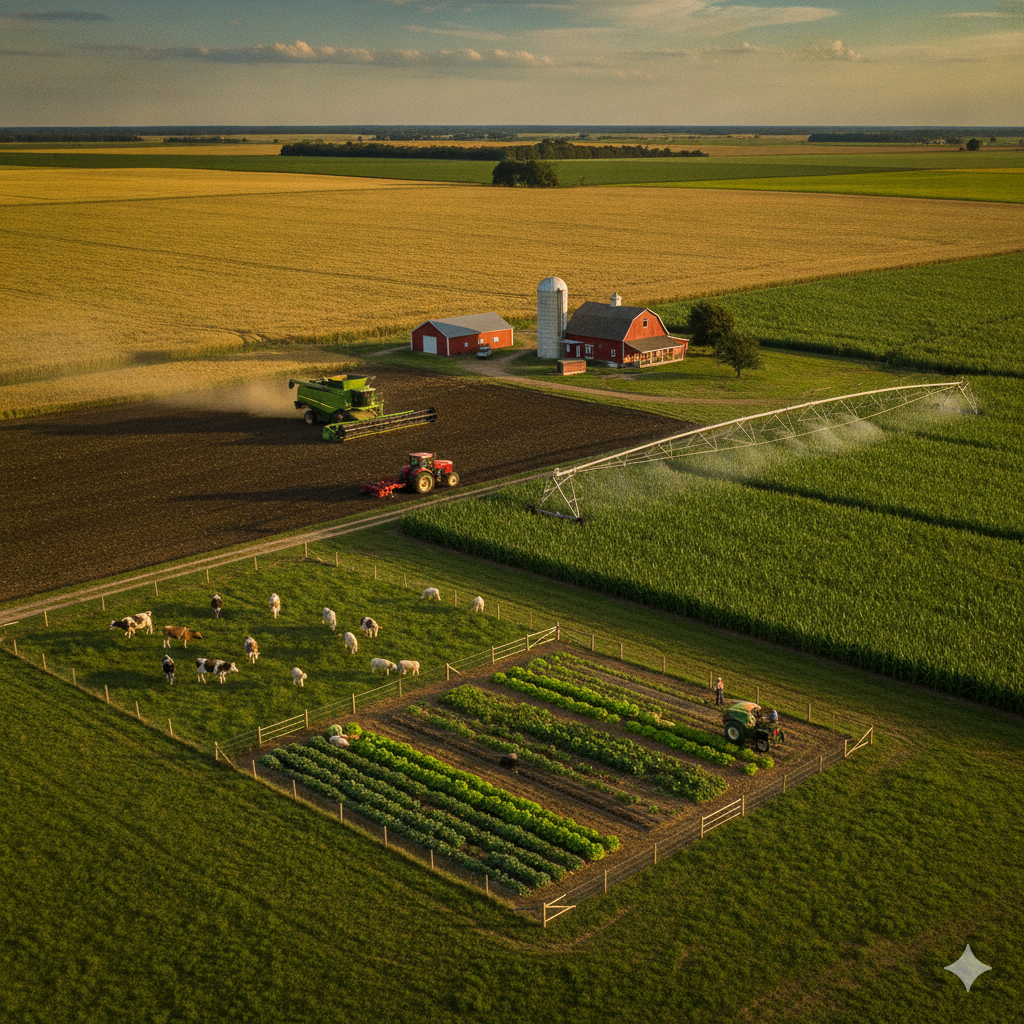
When you combine all three — land, crops, and animals, managed intelligently — you have farming in its complete form.
Where Did Farming Begin?
Farming is approximately 12,000 years old — born at the end of the last Ice Age when human beings made one of the most consequential decisions in history: to stop following food and start growing it.
This transition — from hunter-gatherer to farmer — is called the Neolithic Revolution. It happened independently in multiple parts of the world:
- In the Fertile Crescent (modern-day Iraq, Syria, Turkey) — where wheat, barley, and lentils were first domesticated
- In China — where rice and millet cultivation began along the Yellow and Yangtze rivers
- In Mesoamerica — where maize (corn), beans, and squash were developed into the agricultural foundation of Aztec and Maya civilization
- In India — where farming began in the Indus Valley around 7000 BCE, with wheat, barley, cotton, and sesame among the earliest crops
Before farming, humans lived in small mobile bands. After farming, they built villages, then towns, then cities. They developed writing to keep agricultural records. They created calendars to track planting seasons. They built governments to manage land and water rights.
In other words — farming did not just feed civilization. Farming created civilization.
What Farming Really Involves
Most people imagine farming as a simple act — plant a seed, water it, harvest the crop. The reality is far more complex and demanding.
Modern farming involves:
Land Preparation
Clearing, ploughing, tilling, and conditioning the soil before any crop is planted. This may involve removing weeds, breaking hardpan, adding organic matter, and testing soil pH.
Seed Selection
Choosing the right variety of crop for the soil type, climate, water availability, and market demand. A wrong seed choice can mean an entire season’s loss.
Planting
Timing is everything. Planting too early or too late relative to the monsoon or irrigation cycle can dramatically affect yield. Spacing, depth, and method of planting all matter.
Water Management
Irrigation scheduling, borewell maintenance, drip system management, and rainwater harvesting. Water is farming’s most critical input — and in most parts of India, its most constrained resource.
Nutrient Management
Fertilizing the soil — organically or chemically — to replace nutrients consumed by the previous crop. Soil that is not fed eventually stops producing.
Pest and Disease Control
Monitoring crops for insects, fungal infections, viral diseases, and nutrient deficiencies. Timely intervention can save a crop. Delayed response can destroy it.
Harvesting
Knowing exactly when to harvest — not too early, not too late — and doing so efficiently to minimize post-harvest loss. For some crops, the harvest window is just a few days.
Post-Harvest Handling
Sorting, grading, storing, and transporting produce to market. In India, post-harvest losses account for 15–30% of agricultural output — a massive problem that better farm management can reduce.
Market Linkage
Getting the right price for produce — whether through APMC markets, direct buyer relationships, contract farming, or online agricultural platforms.
Every one of these steps requires knowledge, skill, timing, and investment. Farming is not simple. It is one of the most complex multi-variable management challenges that exists.
Types of Farming
Farming is not a single practice. It is a broad umbrella that covers dozens of different approaches, systems, and scales.
Subsistence Farming
Farming primarily to feed the farmer’s own family, with little or no surplus for sale. Still practiced by millions of small and marginal farmers across India. Low input, low output, low risk — but also low income.
Commercial Farming
Farming at scale, primarily to sell produce in the market. Focused on maximizing yield and profit. Involves significant investment in inputs, machinery, and market linkage.
Organic Farming
Cultivation without synthetic chemicals — using natural inputs like compost, vermicompost, green manure, and biological pest control. Growing rapidly in India due to urban consumer demand and export opportunities.
Mixed Farming
Combining crop cultivation with animal husbandry on the same farm. The animals provide manure for crops; the crops provide fodder for animals. A self-sustaining, efficient system practiced across Karnataka’s rural belt.
Plantation Farming
Large-scale cultivation of a single crop — tea, coffee, rubber, coconut, sugarcane — on a commercial estate. Karnataka is home to significant coffee and arecanut plantations in Coorg and Chikmagalur.
Horticulture Farming
Cultivation of fruits, vegetables, flowers, and ornamental plants. High value per acre, high management intensity. The Bengaluru–Mysuru corridor is one of India’s most productive horticulture zones.
Dryland Farming
Farming in areas with low rainfall and no irrigation, relying entirely on rainwater and drought-resistant crops. Common in North Karnataka where rainfall is sparse and unpredictable.
Irrigated Farming
Farming with supplemental water supply through canals, borewells, or tanks. More productive and reliable than dryland farming. Most managed farmland projects in Karnataka are based on irrigated farming.
Agroforestry
Integrating trees with crops and sometimes livestock on the same land. Combines short-term crop income with long-term timber or fruit tree value. Increasingly popular as both a sustainable farming practice and an investment model.
Contract Farming
A formal arrangement where a company or buyer agrees in advance to purchase a farmer’s produce at a fixed price. Reduces market risk for the farmer. Common in vegetable, spice, and processed food supply chains.
Precision Farming
Technology-driven farming using sensors, drones, satellite imagery, and data analytics to optimize every input — water, fertilizer, pesticide — at the individual plant level. The future of large-scale commercial farming in India.
Farming in India — Scale and Significance
India is an agricultural giant. Consider these numbers:
- Agriculture contributes approximately 17–18% of India’s GDP
- Over 58% of India’s rural population depends on agriculture for their livelihood
- India is the world’s largest producer of milk, pulses, and spices
- India is the second largest producer of wheat, rice, fruits, and vegetables
- Agriculture employs approximately 42% of India’s total workforce
Despite these numbers, the average Indian farmer cultivates less than 2 hectares of land — making Indian agriculture predominantly small and fraginal. This is both a challenge and an opportunity.
The challenge: small holdings make mechanization difficult, market access weak, and income vulnerable.
The opportunity: aggregated managed farmland models — where multiple investors pool land under professional management — can deliver the efficiency of large-scale farming while democratizing land ownership.
Farming in Karnataka — A Rich Legacy
Karnataka has one of the most diverse agricultural landscapes in India.
- The Malnad region (Coorg, Chikmagalur, Shivamogga) produces coffee, spices, and arecanut in lush hill forests
- The Cauvery basin (Mysuru, Mandya) supports irrigated paddy, sugarcane, and flowers
- The Bengaluru rural belt grows vegetables, flowers, and fruits for the city’s massive urban market
- The Northern dry zone (Dharwad, Gadag, Vijayapura) cultivates cotton, sunflower, and pulses on dryland farms
- The Coastal belt (Dakshina Kannada, Udupi) combines rice, coconut, and fisheries
This diversity means Karnataka has suitable land for almost every type of farming — making it one of the most attractive states in India for farmland investment.
What Modern Farming Has Become
Farming today looks very different from what it did even 30 years ago. Technology, market integration, and changing consumer preferences have transformed it.
Drone farming — Drones are now used to spray pesticides, monitor crop health, and map farm boundaries with precision impossible by hand.
Soil sensors — Real-time soil moisture and nutrient sensors allow farmers to irrigate and fertilize exactly when and where needed — reducing waste and improving yield.
Mobile market platforms — Apps like eNAM (electronic National Agriculture Market) connect farmers directly to buyers across India, bypassing traditional middlemen.
Vertical farming — Growing crops in stacked indoor layers with controlled light, temperature, and water. Not yet mainstream in India but growing rapidly in urban food production.
Carbon farming — Farming practices that sequester carbon in the soil are now being monetized through carbon credit markets — creating a new income stream for farmers who adopt regenerative practices.
Farm-to-consumer brands — Farmers and farmland owners are increasingly building direct relationships with urban consumers through subscription boxes, farmer’s markets, and social media — capturing retail margins instead of wholesale prices.
The farmer of tomorrow is part agronomist, part technologist, part brand builder, and part financial manager.
Farming as Investment — The New Reality
For centuries, farming was the occupation of necessity. You farmed because you had to — to eat, to survive, to pay rent.
Today, farming — or more precisely, owning and investing in farmland — has become a choice. A financial decision. An asset strategy.
Globally, institutional investors, family offices, and high-net-worth individuals are allocating capital to agricultural land as:
- A hedge against inflation — farmland values historically keep pace with or exceed inflation
- A real asset — tangible, productive, and not correlated to stock market volatility
- An income generator — through crop production, leasing, agritourism, or managed farming returns
- A legacy asset — land that can be passed down to the next generation
In India, this shift is still early. Most urban professionals and NRIs have not yet thought of farmland as an investment category. That is changing — rapidly — as awareness grows, legal structures improve, and managed farmland models make ownership accessible without requiring the buyer to become a farmer.
The Difference Between Farming and Owning Farmland
This is an important distinction — especially for investors.
Farming is an activity. It requires physical presence, agricultural knowledge, daily management, and hands-on labour.
Owning farmland is an investment. It requires capital, legal due diligence, and the right management partner.
You do not need to be a farmer to own farmland. Just as you do not need to be a builder to own property, or a fund manager to own stocks.
What managed farmland models offer — and what DesiReNest specializes in — is the bridge between the two. You own the land. Professionals do the farming. You receive the income and the appreciation.
It is farming’s productive value — without farming’s daily demands.
Why Understanding Farming Matters for Investors
If you’re considering farmland as an investment, understanding what farming actually is gives you a significant advantage.
You’ll know:
- Why water availability matters more than location alone
- Why soil health determines long-term productivity — and value
- Why certain crops suit your land better than others
- Why a managed farmland project with diversified crops is more resilient than a monoculture
- Why the right farming model on the right land in the right location compounds in value over time
Farming knowledge is farmland investment knowledge. The two cannot be separated